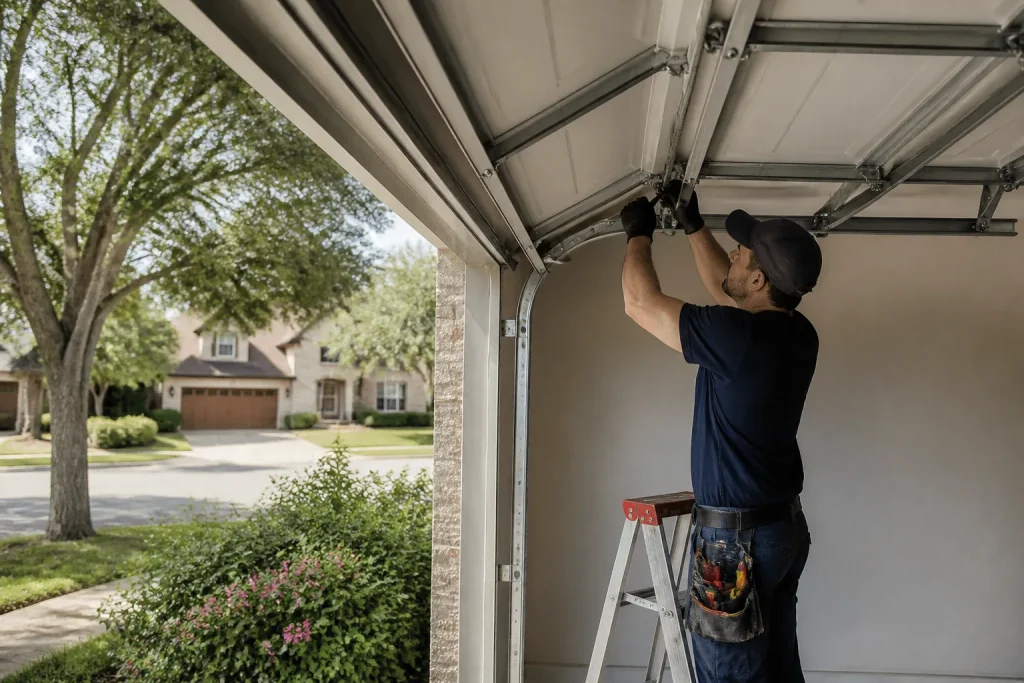
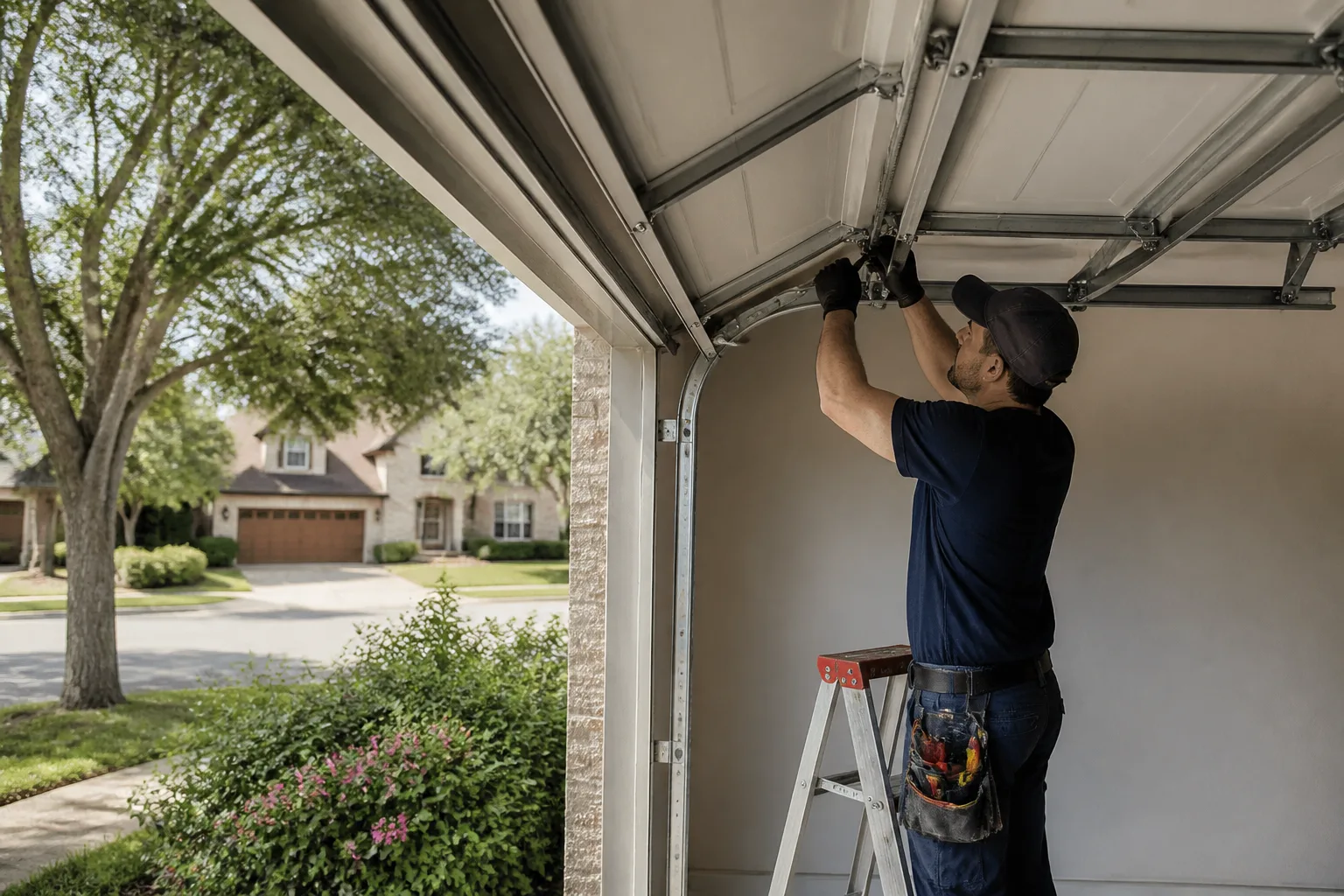
LiftMaster Garage Door Repair in Energy Corridor: A Homeowner’s Guide
Most LiftMaster problems in Energy Corridor turn out to be simpler than the official error code makes them sound. Model 8550W stops halfway and flashes 4-2, a neighbor tells you the logic board is gone, and you brace for a repair bill in the hundreds. Very often it’s a cheap safety sensor wire that has corroded in the garage humidity. Learning to read your own opener saves you from guessing. If you’d rather skip the detective work, call (855) 337-1190.
Key Takeaways
- Error codes point to a symptom, not always a part. 4-2 is a safety-sensor fault, not automatically a board.
- Battery backup units from post-Harvey installs can fail quietly and hide a separate opener problem.
- MyQ dropping off the WiFi in a deep garage isn’t a hardware failure – it’s usually a signal dead zone.
- Some LiftMaster parts need genuine OEM. Others are functionally identical as generic. Knowing which is which keeps the bill honest.
- Ask for an exact quote before work starts, whatever the code says.
What do LiftMaster error codes actually mean?
LiftMaster error codes tell you which circuit tripped, not which component failed. The same code can come from a $22 wire or a $300 board, and the only way to know is to trace the circuit. In Energy Corridor, where garages run hot and humid much of the year, small wiring faults account for a lot of what looks like a failing board.
Here’s a quick decoder for the models we see most in Energy Corridor subdivisions:
- 8550W – flashing 4-2: Safety sensor issue. Usually a misaligned photo-eye, a cut wire, or corrosion at the connector. A failed logic board is possible but far less likely than most people assume.
- 8550W – flashing 1-5 or 1-6: Travel or motor circuit problems. Sometimes a stripped gear in the opener housing, sometimes a limit issue. The motor itself is often fine.
- 8365 belt drive – opens short distance then reverses: Almost always the safety sensor beam being blocked or the sensor bracket knocked loose. LiftMaster’s belt units are sensitive to a sagging bracket on a low-clearance track.
- WLED series – opener runs but light won’t come on: A burned-out LED or a loose connection at the lamp socket. Rarely the main board.
- DC belt drive – clicking and stalling: Gear wear or a bound spring. On a double-spring door, one broken spring can look exactly like an opener failure because the opener stalls under the extra load.
If the code you’re seeing doesn’t match this list, the safest move is to leave the opener power off and have someone who works on LiftMaster systems take a look. Poking inside the housing with the door up and the spring under tension is not a friendly home project.
Why does MyQ keep dropping in large Energy Corridor garages?
MyQ drops because the opener can’t reach your WiFi router, not because MyQ itself is broken. Large Energy Corridor homes often put the garage at the far end of the house, behind the utility room and a brick wall, and the opener’s WiFi radio is weaker than a phone’s. Phantom “connection lost” alerts followed by random reconnects point to signal, not hardware.
What we see on MyQ calls in Energy Corridor:
- The app shows offline but the wall control and remote work normally.
- Errors appear after a router reboot, a new mesh node, or a network name change.
- Two garages on the same house, one connects and the other never does.
Before anyone tells you the opener board needs replacing, check what your router sees. Does the opener appear in your connected device list at all? If it does, the hardware is fine – you have an interference or signal problem. If it never connects even two feet from the router on a temporary move, then you’re looking at a real hardware fault and a trained technician can confirm it. MyQ has been through its own firmware changes over the years, and a stale connection can usually be refreshed without swapping anything. A homeowner who knows the difference avoids paying for a new board on a $0 diagnosis.
Can a battery backup unit hide a real LiftMaster problem?
Yes. Battery backup units installed on many post-Harvey LiftMaster setups can keep the door moving when the main power or the control board is failing, which masks the fault. You see a door that opens slowly or erratically, blame the opener, and the real culprit is a dying battery pack the unit keeps drawing from.
What to watch for:
- The door moves under battery only, which should mean a power problem – not a motor problem.
- The battery backup beeps but the door won’t move: the pack is likely shot and needs replacing, not the opener.
- Everything runs but the door struggles: check the springs before the opener. A weak spring and a healthy opener is a common mismatch in these homes.
The backup battery is a consumable part. It has a useful life, and in a hot Energy Corridor garage that life runs shorter than in cooler climates. If your unit is several years past install and the door behaves oddly, ask a technician to test the battery pack and the capacitors before anyone reaches for a new logic board.
Does LiftMaster’s factory warranty cover Energy Corridor repairs?
Sometimes. LiftMaster factory warranties cover defects in the motor, board, and certain parts for a set period, but they do not cover labor, and they don’t cover damage from a bad installation or a related spring failure. The coverage window depends on the model and the original purchase date, which is why the documentation matters.
To give yourself the best shot at a warranty claim on a LiftMaster opener in Energy Corridor, keep:
- The original purchase receipt or installer invoice showing the date and model number.
- The opener’s serial number (usually inside the light lens housing or on a label under the cover).
- A note of the symptom and any error code you saw.
If you don’t have the paperwork, the manufacturer can sometimes trace the model by serial number, but it isn’t guaranteed. A little record-keeping on the front end saves a lot of friction on the back end. The parts in a LiftMaster opener that carry the longest warranty terms are typically the motor and control board, not the safety sensors, remotes, or batteries. We’re happy to point you to the model’s published terms when you have the details in hand.
Which LiftMaster parts need genuine OEM, and which don’t?
Genuine OEM matters most for the control board, the motor, and the safety sensor assembly, because small differences in firmware and signal timing cause real problems there. Remotes, batteries, belt and chain kits, and roller brackets can be sourced as standard parts with no practical difference. It’s the electronics that reward the OEM choice.
- Go OEM: logic board, motor, safety sensor pair, anything that talks to MyQ.
- Generic is fine: batteries, belts, chains, hinges, rollers, wall brackets, torsion cables.
- Judgment call: springs – quality matters more than brand, and installation technique matters more than both.
When a technician quotes a LiftMaster board, ask whether it’s OEM or aftermarket. A good shop will tell you why. This matters because a generic board can fail within weeks on a model that’s already finicky about network communication, and the labor to reinstall it costs more than the part savings. For older Energy Corridor homes still running a Chamberlain, Genie, or Wayne Dalton unit under a LiftMaster canopy, the parts picture shifts slightly, and a technician who works across brands can recommend honestly. That’s why Garage Door Repair Energy Corridor services the full range of major brands rather than one manufacturer’s lineup.
When should you call a pro on a LiftMaster system?
Call a pro when the opener runs but the door won’t lift, when the door lifts unevenly, when any spring is involved, or when the error code won’t clear with the power cycled twice. Those symptoms cross into structural and spring territory, and a trained technician is the right call. If you’re confident it’s a remote pairing issue or a blocked sensor, a homeowner can usually sort that independently.
Springs deserve special mention. They’re under heavy tension, and the tools and techniques for safe replacement aren’t in a typical home toolbox. For springs, always use a trained professional. That’s a big part of why our team keeps garage door repair in-house rather than subcontracted – a LiftMaster call that turns out to be a spring problem gets resolved in one visit. For opener-only issues, we can also handle garage door opener repair directly. If your opener is an older unit and a replacement is the better play, we handle garage door installation too. Our technicians have up to 8 years of experience, and they’ve seen the full LiftMaster lineup from the WLED back to the earliest belt drives.
Related services in Energy Corridor: opener repair, spring repair, parts sales, and full installations. One call covers the whole system.
The Bottom Line
Most LiftMaster calls in Energy Corridor start with a scary error code and end with a much smaller repair than the homeowner feared. Read the code carefully, check the safety sensor before you accept a board diagnosis, test the battery backup, and ask whether a quoted part is OEM. That little checklist protects you from the most common expensive oversells on the LiftMaster systems that dominate these homes.
If you’re in Energy Corridor and need help, Garage Door Repair Energy Corridor offers free estimates – call (855) 337-1190. We work on your brand, not just one manufacturer’s, and we’ll tell you what’s actually going on before any work starts.
Frequently Asked Questions
No, 4-2 usually means a safety sensor fault, not a logic board. The most common causes are a misaligned photo-eye, a cut or corroded wire, or a sagging sensor bracket. Test the sensor alignment first, then call (855) 337-1190 for a free estimate if the code keeps coming back.
If the wall control and remote work, your opener is running fine and you have a WiFi signal problem. Large Energy Corridor garages often sit at the edge of the home’s router range. Move the router or add a node near the garage before you consider replacing the board. Call (855) 337-1190 if it never connects at all.
Most LiftMaster repairs are quoted after we confirm the fault, and the written quote is the price before any work begins. Safety sensors, remotes, and batteries sit at the low end; boards and motor replacements sit higher. Call (855) 337-1190 for an exact quote, and estimates are free.
Factory warranty can cover certain parts if the unit is within its coverage window and you have the serial number and purchase date, but it doesn’t cover labor. Keep your paperwork. Call (855) 337-1190 and we’ll help you figure out what the model’s published terms allow.
Yes. We service LiftMaster, Chamberlain, Genie, Clopay, Amarr, Wayne Dalton, Craftsman, and Raynor, so your recommendation is based on your system, not on one brand’s sales pitch. Call (855) 337-1190 to book a free estimate.
Written by the team at Garage Door Repair Energy Corridor.
Need Garage Door Help?
Call Garage Door Repair Energy Corridor - the local pro we connect you with is licensed and insured, here with fast after-hours help in Energy Corridor.
(855) 337-1190